This Content is Sponsored by

When it comes to craft beer, I find that history and provenance elevate the experience—and no corner of the world offers more of both than Europe.
From the crisp lagers of the Czech Republic to the revered Trappist ales of Belgium and the Netherlands (La Trappe, I see you!), each glass holds centuries of tradition, history, and wisdom. And as brewers, we have the privilege of tapping into those legacies—if we take the time to learn this ancient craft.
I remember wandering the narrow, rowhouse-flanked streets of Belgium, stumbling upon a centuries-old pub with splintered wooden beams and stained-glass windows. A heavy door with iron inlays beckoned me inside, its weighty creak hinting at the history within. A dark, worn wooden staircase lured me upward, leading to a magnificent cathedral of a tasting room, bathed in an almost holy light as the winter clouds outside seemed to part just for this space. The beertender poured me a radiant Golden Strong, its meringue-like foam clinging to the glass as a million microbubbles fled from the etchings of the bulbous snifter’s nucleated bottom. A feast for the eyes, no doubt—but that first sip, taken while gazing over the medieval town square of Brugge, was something more. It was a draught of history, a quenching of the soul’s thirst—the kind of drink that lingers not just on the tongue, but in memory. This clearly wasn’t just a beverage; it was a story in liquid form.
Belgian ales, with their deep complexity and time-honored mystique, invite quiet reflection—beers to be savored slowly, their stories unfolding sip by sip. But brewing traditions are as varied as the people who uphold and consume them, and not all great beers are meant to be contemplated in hushed reverence. Some are meant to be lived with, worked alongside, woven into the fabric of everyday moments. If Belgian ales are liquid poetry, then the humble Hefeweizen is a joyful melody—unapologetically bright, effortlessly drinkable, and brewed for the everyman. It is for this appeal that Hefeweizen is the beer I most reach for, brew the most frequently, and find to be the most gratifying ale a homebrewer can craft. Its clear and near-immediate feedback on process and recipe both rewards the maker and allows him to improve each iteration quickly.
I still remember my first sip of a Weihenstephaner on a warm summer afternoon in a shaded beer garden, the hourglass-like vessel sweating on the bistro table as the beer’s golden haze caught a ray of sunlight poking through the creeping hop vines overhead. The first taste was a rush of banana and spice, accompanied by a softness on the tongue and a bready warmth that was both familiar and surprising. Its cheery blond glow, pillowy mouthfeel, and unmistakable clove essence put it levels ahead of the domestic craft beers I was enjoying at the time. Years later, when I began brewing, I realized recreating this experience was the benchmark I wanted to reach as quickly as possible.
Hefeweizen was the first beer that I ever brewed, and I still remember the nervous excitement of that first batch. The garage ended up a mess of sticky wort splatter and spent grains, and for the next ten days, I hovered over my fermenter like it held the secrets of the universe. That first creation wasn’t perfect, either, but it was of my own making—and it sparked an obsession. Since that first foray into brewing, hundreds of brew days and dozens of Hefeweizen batches have commenced, and I’ve refined my recipe in pursuit of those very flavors I enjoyed on that sunny July afternoon.
Brewing Hefeweizen with Montana Craft Malt
When it comes to recipe design, I’ve always been somewhat of a purist. When brewing English beers, I use Maris Otter. For Belgians, Dingeman’s is my go-to. And for Weissbiers, I’ve always defaulted to German malts. But is it possible to brew a convincing Hefeweizen using American malts? Could they even make a superior beer?
Thanks to our homebrew club’s (Mash Out Boyz) sponsor, Montana Craft Malt, I had the opportunity to test this question—and my own brewing dogma.
I brewed two batches of Hefeweizen using my tried-and-true recipe listed below. Everything about the process was identical: same mash schedule, water treatment, yeast pitch and fermentation regimen, nearly identical OGs and FGs. The only variable was the malt. One batch was brewed with imported Weyermann malts, the other with domestically grown and produced malts from Montana Craft Malt.
I then conducted a blind triangle test at my local homebrew club’s monthly meeting. Ten experienced tasters, including BJCP judges, award-winning homebrewers, the owner of a revered local brewery and his brewer, were presented with three samples—two of which were the same. Their task was to identify the odd beer out and guess the variable.
To indicate a real, detectable difference, at least six tasters would need to correctly pick the odd beer out. Only three managed to do so, and none of them correctly identified the variable being tested. This suggests that most tasters couldn’t reliably distinguish between a beer brewed with authentic German malts and one brewed with American-grown malt.
However, preference told a different story. When asked which beer they liked best, every single taster—100% of respondents—preferred one of the two glasses containing the Hefeweizen brewed with Montana Craft Malt. Those who correctly identified the odd beer out noted that the Weyermann version, had a thinner, more acidic quality, with less pronounced clove phenols. For this small group, the Hefeweizen brewed with domestic malts was the universally favored beer.
What This Means for Homebrewers
Even knowing the variable, I struggled to pick out the odd beer in blind tastings. The beers were remarkably similar—aroma, mouthfeel, appearance, and taste were consistent across all three samples. My takeaway? A majority of tasters could not reliably distinguish between a Hefeweizen brewed with domestically produced malt and one brewed with imported German malt.
It’s possible that yeast expression overshadowed subtle differences in the grain. Perhaps a more delicate style, like a Pilsner, would be a better indicator of malt character. Freshness might also be a factor—domestic malts may arrive at my local homebrew supply fresher than those that have traveled thousands of miles in a shipping container before making it to the shelves.
For a style that many brewers, including myself, have long believed must be brewed with authentic German ingredients, this experiment suggests that malt origin may not matter as much as previously thought. In fact, choosing domestic malts might not only result in an equally authentic Hefeweizen—it might even create a better, fresher one.
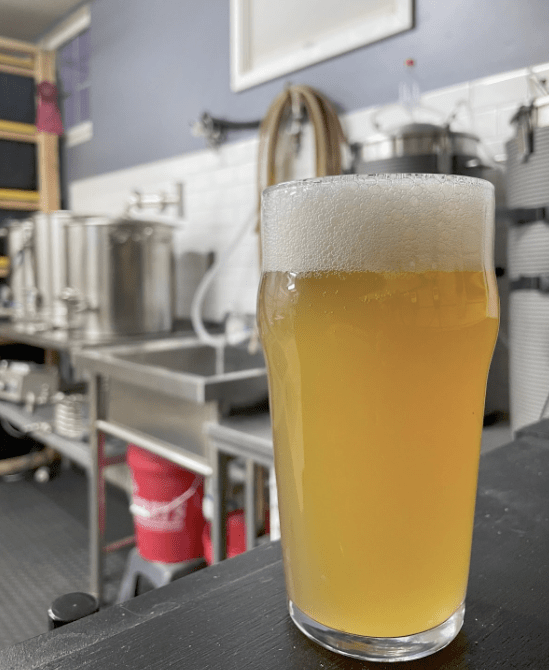
Hefeweizen Recipe:
- Original Gravity: 1.053
- Final Gravity: 1.013
- Abv: 5.25%
- IBU: 15
Grain Bill:
- 61% Pale White Wheat – Montana Craft Malt
- 37% Bavarian Pilsner – Montana Craft Malt
- 2% Melanoidin Gold – Montana Craft Malt
- Rice hulls (not calculated in grain bill percentages–I use 0.5# per 5 gallon batch
Hopping: BU/GU Ratio of 0.28
- 13.5 IBU at 60 minutes: Hallertau Mittelfrüh
- 1.5 IBU at 15 minutes: Hallertau Mittelfrüh (roughly ¼ oz per 5 gallon batch)
Yeast: Imperial Stefon/Wyeast3068 (Weihenstephaner strain) or WLP300
Mash Schedule:
- 120F – Dough in, 20 minutes’ rest
- 147F – 20 minutes’ rest
- 154F – 1 hour
- NO Mash out.
Water Chemistry:
- Ca 65
- Mg 13
- Na 10
- Cl 95
- SO4 65
- Mash pH 5.5 (to account for acidifying tendency of wheat malt in the finished product)
I pitched this beer at an inoculation rate of approximately 0.75M/mL/P with minor aeration and no supplemental oxygenation, and I fermented it at 66F for the first 3 days before raising it 1F per day until I reached 70F. I then held it at 70F for a few days until confirming I’ve reached final gravity and that the sulfur aromas have dissipated. Finally I packaged without crashing and carbonated each keg to a spritzy 2.75 volumes of CO2.
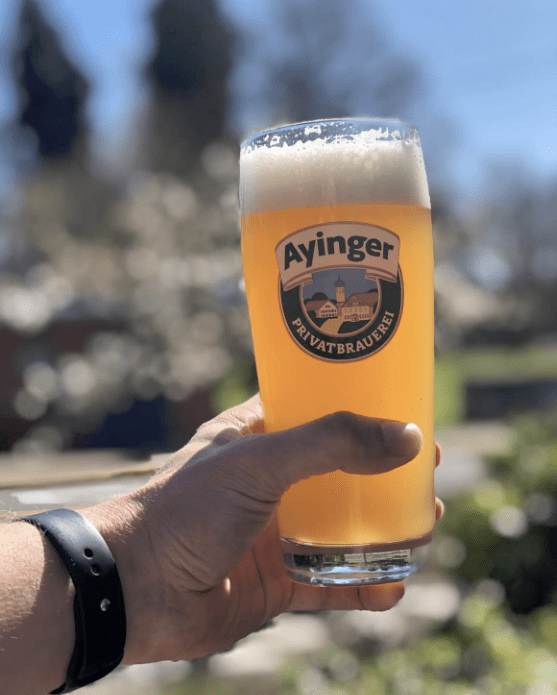
Final Thoughts:
Much of the homebrewing dogma around Hefeweizens does not hold up in my testing. I’ve underpitched this beer, withheld aeration and have fermented warm in the past, and have been disappointed each time. I’ve found that grist composition (but not origin), mash and fermentation schedules are far more impactful–and controllable–than pitch rates and trying to toe an imaginary line between creating conditions that stress out yeast without spilling over into bad fermentation territory. Follow this regimen and you too will produce a Hefeweizen worthy of the friar on the Franziskaner bottle’s praise.
By Nick Boyd, Moonrise Brewing
Follow Nick on Instagram
Discover more from MASHOUT MAGAZINE
Subscribe to get the latest posts sent to your email.
