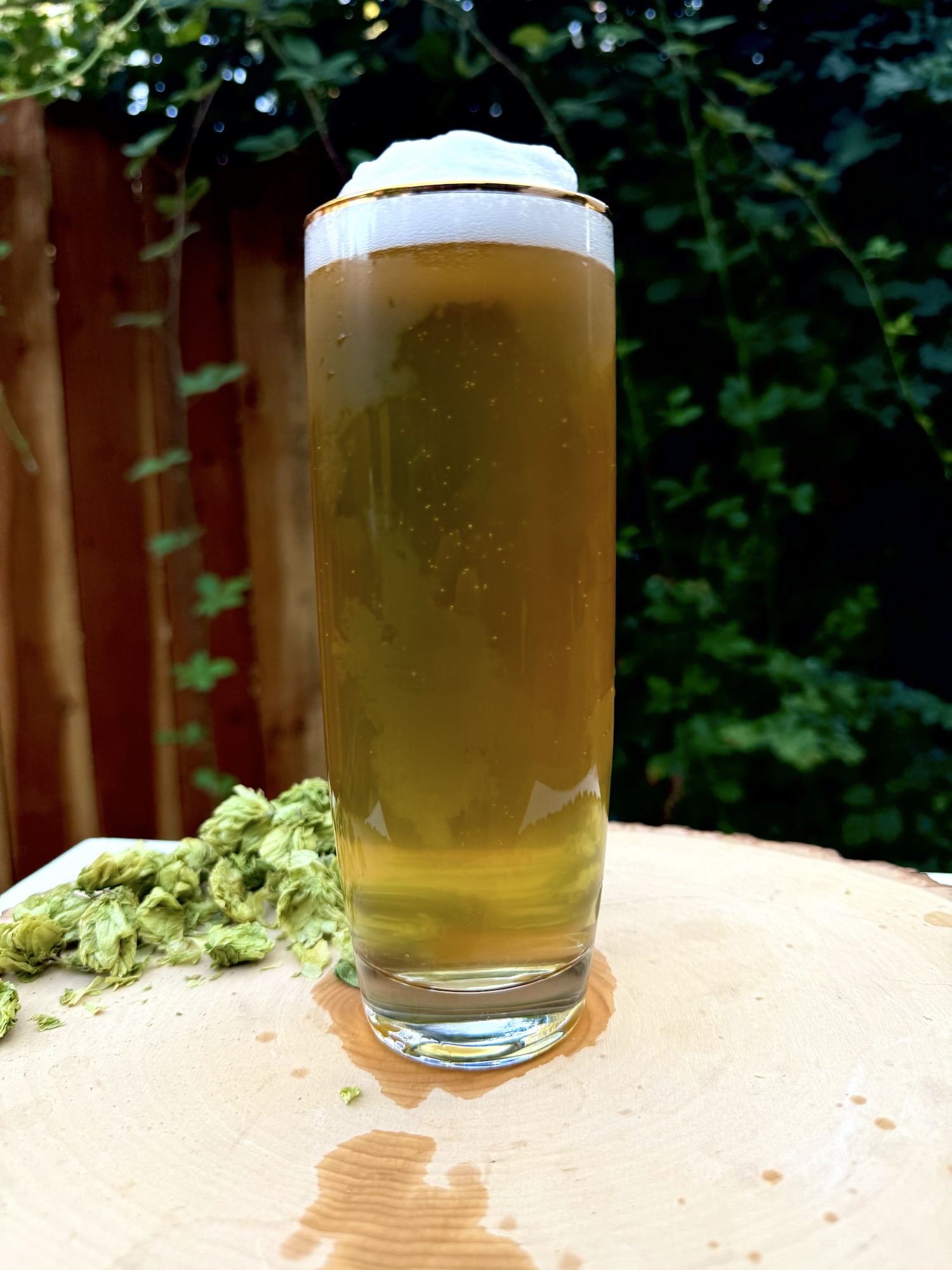

As someone who is pretty much lager-focused in my brewing, I don’t usually spend much time thinking about American Lagers. That changed after a trip to San Diego. I tried the Kernza Lager from Pure Project and walked away wanting to brew my own take on a sustainable lager built around organic ingredients. Kernza is tough and pricey to source as a homebrewer, and Montana Craft Malt doesn’t offer an organic option, so I turned to Admiral Maltings in California since they grow and sell some organic varieties. The yeast was trickier. White Labs strains in the States aren’t certified organic, only the ones coming out of Copenhagen, so I had to work around that. I also used clarity ferm to help drop the gluten levels in the finished beer. I don’t usually rely on clarity finings. When I lager my beers I stick to a slow cold crash, cold temps, and time.

This approach ended up paying off because this recipe went on to score a 45 out of 50 in the 2025 Badger Brew off competition, which was a pretty awesome surprise for something that started as a simple experiment in sustainability.

Check out the recipe!
69% efficiency
Batch Volume: 5.5 gal (20.8 L)
Boil Time: 60 min
Mash Water: 4.52 gal (17.1 L)
Sparge Water: 3.16 gal (12.0 L)
Total Water: 7.68 gal (29.1 L)
Boil Volume: 6.8 gal (25.8 L)
Pre-Boil Gravity: 1.041
Vitals
Original Gravity: 1.047
Final Gravity: 1.010
IBU (Tinseth): 18
BU/GU: 0.38
Color: 3.4 SRM
Mash
Temperature — 152 °F (67 °C) — 60 min
Malts (10 lb)
10 lb (4.54 kg) (100%) — Organic Admiral Maltings Admiral Pils
Hops (1.5 oz)
1 oz (28 g) (15 IBU) — Organic Adeena 4.2% — 60 min
0.5 oz (14 g) (3 IBU) — Organic Adeena 4.2% — 10 min
(Non-organic is fine too)
Miscs
1 items — Whirlfloc — Boil — 10 min
0.5 tsp — Yeast Nutrient — Boil — 10 min|
1 items — Clarity Ferm — Primary (Solely for the Gluten Level Reduction)
Yeast
1 pkg — White Labs WLP840 American Lager Yeast
Fermentation
Primary — 52 °F (11 °C) — 7 days
Diacetyl Rest — 59 °F (15 °C) — 5 days
Cold Crash — 36 °F (2 °C) — 3 days
Water Profile
Ca2+ 12
Mg2+ 4
Na+ 6
Cl– 13
SO42- 37
HCO3– 3
By Jordan V, Billy’s Tavern Homebrewing
Jordan is a California native. When he is not brewing he can be found drinking beer with friends, duck hunting, and getting lost in a good book or video game. When he is not out on an adventure with his wife, he can be found at home with his two lovable dogs. Stay up to date by following him on Instagram.


The Mashout Magazine wants to thank White Labs for partnering with us to not only be able to share information like this, content including recipes and experiments around their strains. They are also offering homebrewers 5% off homebrew pouches from them directly. You can use code “MashMag” for 5% off your order all year long!
Shop strains here

Check out some more great content!

Inside White Labs: Yeast Tour with Oil Creek Brewing!
Did you know White Labs has its own brewery along with its famed yeast propagation laboratory? White Labs is well known for its yeast. Since its early origins in California in 1995 but what you maybe didn’t know is that it has a very interesting approach to their brewery. I was fortunate enough to meet…


More Than Grain: Why Great Beer Starts with Montana’s Local Malt
In craft beer, people often talk about hops, yeast, and brewing techniques, but every great beer starts with malt. Over the last several years, Montana Craft Malt has built a reputation that goes beyond simply supplying grain. They have become a trusted partner for brewers who value quality, consistency, and a connection to where their…

CellarScience Instant Water: Simplifying One of Brewing’s Most Confusing Starting Points
Water chemistry is one of those things almost every homebrewer eventually gets told they need to learn. So you start reading about it, and before long you’re staring at water reports, sulfate and chloride ratios, mash pH targets, and calculators that make your head spin. At least that was my experience. Brewfather has helped a…

Leave a Reply