As of late, liquid yeast has enjoyed the prestige position in the brewing world — often seen as the go-to for serious brewers chasing nuance, variety, and performance. Dry yeast? Long considered the budget option or the beginner’s backup. But times are changing, and fast.
Thanks to innovation from industry leaders like White Labs, the dry yeast stigma is finally cracking. The release of WLP860 Munich Helles Lager in dry pitch form is a clear sign that dry yeast is not only catching up, but that it’s stepping confidently into the ring.
The Legacy of Liquid
It’s no mystery why liquid yeast became the darling of craft and homebrewers alike. Liquid strains traditionally offer broader selection, are often first to market with novel or region-specific strains, and are perceived to be more “true to style.” The pitch rates are well-established, and many brewers love the ritual and customization that comes with using liquid cultures, like starters, oxygenation, temperature dialing.
But liquid yeast comes with its own challenges: shorter shelf life, cold chain shipping, and variable viability.
The Dry Yeast Renaissance
Dry yeast has been catching up rapidly in terms of strain variety, fermentation performance, and consistency. Companies like Lallemand and Fermentis have been impactful, but White Labs’ entry into the dry yeast game is particularly exciting.
WLP860 Munich Helles Lager as a dry pitch is a game-changer. It’s the same strain known for producing clean, malty, German-style lagers with elegant hop balance, but now in a shelf-stable, easy-to-use dry format. For homebrewers and pros alike, that means fewer cold storage headaches, reduced waste, and more flexibility in planning brews.
Performance vs. Perception
The idea that liquid yeast is inherently “better” is increasingly a holdover from the past. In blind tests, dry yeast often performs on par with — and sometimes exceeds — liquid equivalents. Most modern dry pitches are clean fermenters, and require little to no rehydration.
Sure, liquid yeast still wins in the sheer variety of niche strains. If you’re chasing the yeast from a Belgian monastery or a specific Norwegian farm, liquid’s still your best bet. But for a vast majority of beer styles — like lagers, NEIPAs, and American ales — dry yeast is more than up to the task.
A Tool, Not a Tier
At the end of the day, yeast is a tool in the brewer’s kit, and not a hierarchy. The right choice depends on your recipes, and your setup. But with releases like WLP860 Dry, the gap between perception and performance is closing.
Many will argue that the choice between dry and liquid yeast comes down to a brewer’s access to a local homebrew shop, whether they need to rely on shipping, beer style, or simply personal preference. And to a large extent, they’re right. There’s no one-size-fits-all answer, and it’s not always fair to claim that one form is universally better than the other. The goal of this article isn’t to settle that debate. Instead, it’s to shed light on the remarkable advancements in dry yeast over the past several years. Once seen as a lower-tier option with limited strain variety and questionable viability, dry yeast has undergone a quiet revolution. Today’s offerings are more diverse, reliable, and performance-driven than ever before.
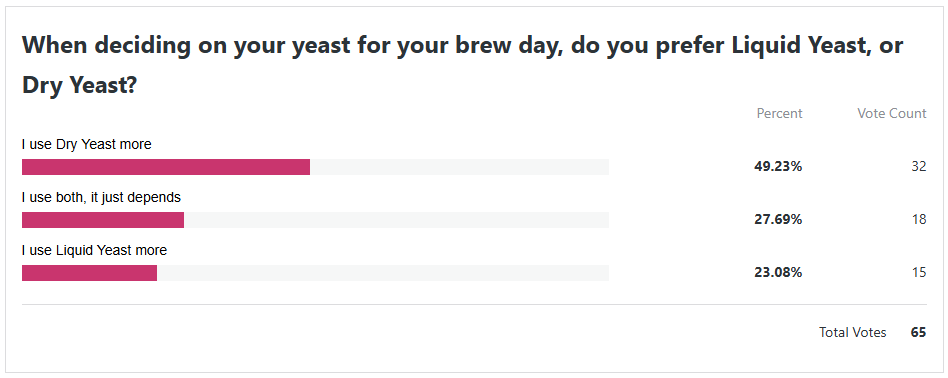
To get a better sense of current preferences, I ran a quick poll asking fellow homebrewers whether they prefer dry yeast, liquid yeast, or a mix of both. Out of 65 responses, over half (51%) said they use dry yeast more often. Only 23% said they prefer liquid yeast, while 27% said it depends on the brew. That surprised me, especially given how often liquid yeast is positioned as the “superior” option in homebrew communities.
This shift in usage might not be just about convenience anymore, it may also reflect growing trust in dry yeast as a legitimate, quality choice that deserves a permanent place in every brewer’s toolkit.
Want to learn more about White Labs Premium Dry Strains? Click Here.
I recently brewed a Helles Lager using a dry pitch of WLP860, and I have to say, it absolutely nailed it. Fermentation was quick, clean, and smooth. The final product was spotless! No off-flavors, no issues. In fact, this might be the best Helles I’ve brewed yet. I was genuinely impressed with the performance and simplicity of using a dry pitch for a lager, especially considering how yeast health is so critical at cooler fermentation temperatures.
Check out the recipe using dry pitch WLP860 by clicking here.
By Jordan V, Billy’s Tavern Homebrewing
Jordan is a California native. When he is not brewing he can be found drinking beer with friends, duck hunting, and getting lost in a good book or video game. When he is not out on an adventure with his wife, he can be found at home with his two lovable dogs. Stay up to date by following him on Instagram.

Subscribe to be entered to win free yeast! Learn more.
Check out our most recent articles!

Crafting an Organic American Lager: A Sustainable Approach That Paid Off with Billy’s Tavern
As someone who is pretty much lager-focused in my brewing, I don’t usually spend much time thinking about American Lagers. That changed after a trip to San Diego. I tried the Kernza Lager from Pure Project and walked away wanting to brew my own take on a sustainable lager built around organic ingredients. Kernza is…

Brew a Heavily Saturated Hazy IPA with Mishicott Brewing
There is always a special kind of beauty in brewing a big hoppy IPA at home. It is the fun of building a recipe that pushes flavor to its limit and the satisfaction of watching it come together in the glass. Pheonix is one of those beers that reminds you why the process matters. It…

From Field to Fermentor: Believing in American Malt
For a long time, homebrewers have been told that imported malt is the gold standard. If it’s not from Germany or the U.K., it’s not the “real thing.” You hear people say they only use Weyermann for lagers or Crisp for English ales. Those are great malts, no doubt, but it’s time we start giving…
Discover more from MASHOUT MAGAZINE
Subscribe to get the latest posts sent to your email.
