
A few months ago, one of my closest friends fulfilled a long-held dream and moved his family from California to the U.K. His goal wasn’t just adventure — it was about building a new life, stepping away from the relentless pace of the Bay Area, and seeking something quieter, steadier, and, in some ways, truer to his vision of authenticity. In settling into a slower, gentler suburb of London, he found himself confronted by a rhythm of being that felt foreign at first: it was less compartmentalized, less rushed, more communal than what he experienced at home.
He described to me the small but striking moments that marked this shift — watching friends and colleagues, fresh off a day’s graft, gathering at the local pub for a pint. Not as a special occasion, not because it was Friday, but because that’s just what you do. There was no stress about rushing home through traffic, no sense of guilt over lingering with workmates a little longer. Instead, there was banter, laughter, and shared time — a blending of work and leisure that felt seamless. The pub wasn’t an escape; it was a vital part of the day’s natural flow.
What struck him — and what resonates so deeply with me as someone who has also lived in Western Europe (the Netherlands) and observed folks doing the same without a second thought — is how these small rituals are held together by something so simple yet so profound: the beverage itself. In this example, the accompanying libation is none other than the Best Bitter.
Best Bitter: The Beer of Camaraderie
Best Bitter is a beer of remarkable humility and quiet strength. At first glance, it’s not a style that dazzles with high alcohol or flashy adjuncts. It isn’t brewed to be the center of attention at a beer festival or released in limited quantities with obnoxious, pay-in-advance drink tickets.. But that’s exactly what makes it beautiful. With its low ABV — usually in the 3.8% to 4.6% range — it’s a beer designed for the long haul. It invites you to stay for another. And another. Not because you’re chasing a buzz, but because the beer is as much about the space between sips as the drink itself.
The flavor? Balanced. A gentle biscuity malt backbone, often featuring subtle caramel and light toffee notes, always held in check by an earthy, floral bitterness that never overwhelms–thanks to the wonderful flavor profile of late addition Fuggles. The carbonation is soft, the mouthfeel smooth, the finish dry and satisfying. Often on cask but perfectly fine when served on nitrogen or Co2 at low pressure, it’s a beer that’s approachable for the working man, rewarding for the connoisseur, and ideal for the social butterfly who wants an easy drinking pint in hand while conversation flows.
Best Bitter complements its setting. It is the backdrop to banter, to storytelling, to quiet reflection. It doesn’t demand to be analyzed (though us homebrewers and beer enthusiasts find it easy to do so–and enjoy the process of thinking about it and tasting it with intention). It can be both sessioned in the company of good friends on a warm afternoon or sipped slowly by oneself during a cool and damp English night. There’s a deep honesty in its versatility, and that speaks volumes about the intangible value of this well-designed ale.
A Cultural Staple
There’s something poetic about a style that doesn’t shout, that doesn’t strive to stand out in a crowded market of ever-bolder beers. It’s not a bitter bomb with a ridiculous name or a bougie, bank-breaking hop bill–even its design embodies its accessible, digestible, understandable, affordable qualities. Best Bitter exists because it always has, and because it fits — perfectly — into a culture that values connection, tradition, and shared time. It’s the beer of the everyman. The pint that pairs as well with a laugh as it does with a sigh. It is the beer equivalent of a companion, and it provides an ambience of its own that every pub owner and brewery operator tries to nurture.
In a way, I envy my friend. Not just for his bold move, but for living in a place where a Best Bitter isn’t a curiosity or a rare find. Where it’s simply there, waiting at the end of the day to remind you to slow down, sit together, and appreciate life’s small moments. The Best Bitter is the beer of being present–in the here and now–and I’d bet the farm on existing in the present as being the true meaning of life.
Until I can share a pint with my mate again on his new soil, this Best Bitter is as good a companion as any.
Best Bitter – by Moonrise Brewing
This beer won the “People’s Choice Award” at my local homebrew club’s 2025 Real Ale competition and social. I served this beer in a manner that mimicked cask conditioning, though I’ve had it from both my nitro tap and on normal co2 – and each has its own merits. Here’s how I brewed it:
Stats:
OG: 1.045
FG: 1.012
ABV: 4.4%
IBU: 40 (tinseth)
SRM: 9.0
Grain Bill:
82% Simpson’s Finest Pale Ale; Maris Otter
10.6% Torrified Wheat
5.9% British Crystal, 60 Lovibond
1.5% UK Pale Chocolate – late mashtun addition
Hops:
34.5 IBU of Northern brewer at 60 minutes
5.5 IBU of Fuggles at 10 minutes
2 oz Fuggles at flameout (1 oz per 5 gallons)
Yeast:
White Labs WLP037 – Yorkshire Square Ale Yeast or West Yorkshire – Wyeast 1469
Water Profile:
Ca: 51|
Mg: 4
Na: 16
Cl: 40
SO4: 40

Final Thoughts:
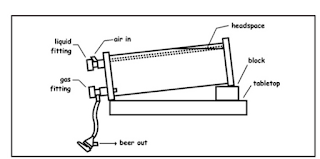
To mimic cask conditioning, swap the posts on your keg so that the Co2-in post has the dip tube, and the “out” fitting is in the CO2-in configuration. Carbonate the keg itself to 1.7 volumes of Co2 via table sugar, dextrose, or other clean fermentable. After carbonating in this fashion at room temperature for a few weeks, just as you would a beer bottle, chill the keg to 45-50F. When serving, lay the keg on its side and place the liquid-out post at the bottom. Angle the keg with a wedge so that the bottom of it is higher than the serving side–this will limit sediment uptake. Hook up a Co2 tank to the new in post and set your regulator to 2-3 PSI to prevent oxygen ingress during dispensing. This will ensure your keg does not get oxidized in the event your party patrons don’t blow the keg.

Check out more great content!

Crafting an Organic American Lager: A Sustainable Approach That Paid Off with Billy’s Tavern
As someone who is pretty much lager-focused in my brewing, I don’t usually spend much time thinking about American Lagers. That changed after a trip to San Diego. I tried the Kernza Lager from Pure Project and walked away wanting to brew my own take on a sustainable lager built around organic ingredients. Kernza is…

Brew a Heavily Saturated Hazy IPA with Mishicott Brewing
There is always a special kind of beauty in brewing a big hoppy IPA at home. It is the fun of building a recipe that pushes flavor to its limit and the satisfaction of watching it come together in the glass. Pheonix is one of those beers that reminds you why the process matters. It…

From Field to Fermentor: Believing in American Malt
For a long time, homebrewers have been told that imported malt is the gold standard. If it’s not from Germany or the U.K., it’s not the “real thing.” You hear people say they only use Weyermann for lagers or Crisp for English ales. Those are great malts, no doubt, but it’s time we start giving…
Discover more from MASHOUT MAGAZINE
Subscribe to get the latest posts sent to your email.
