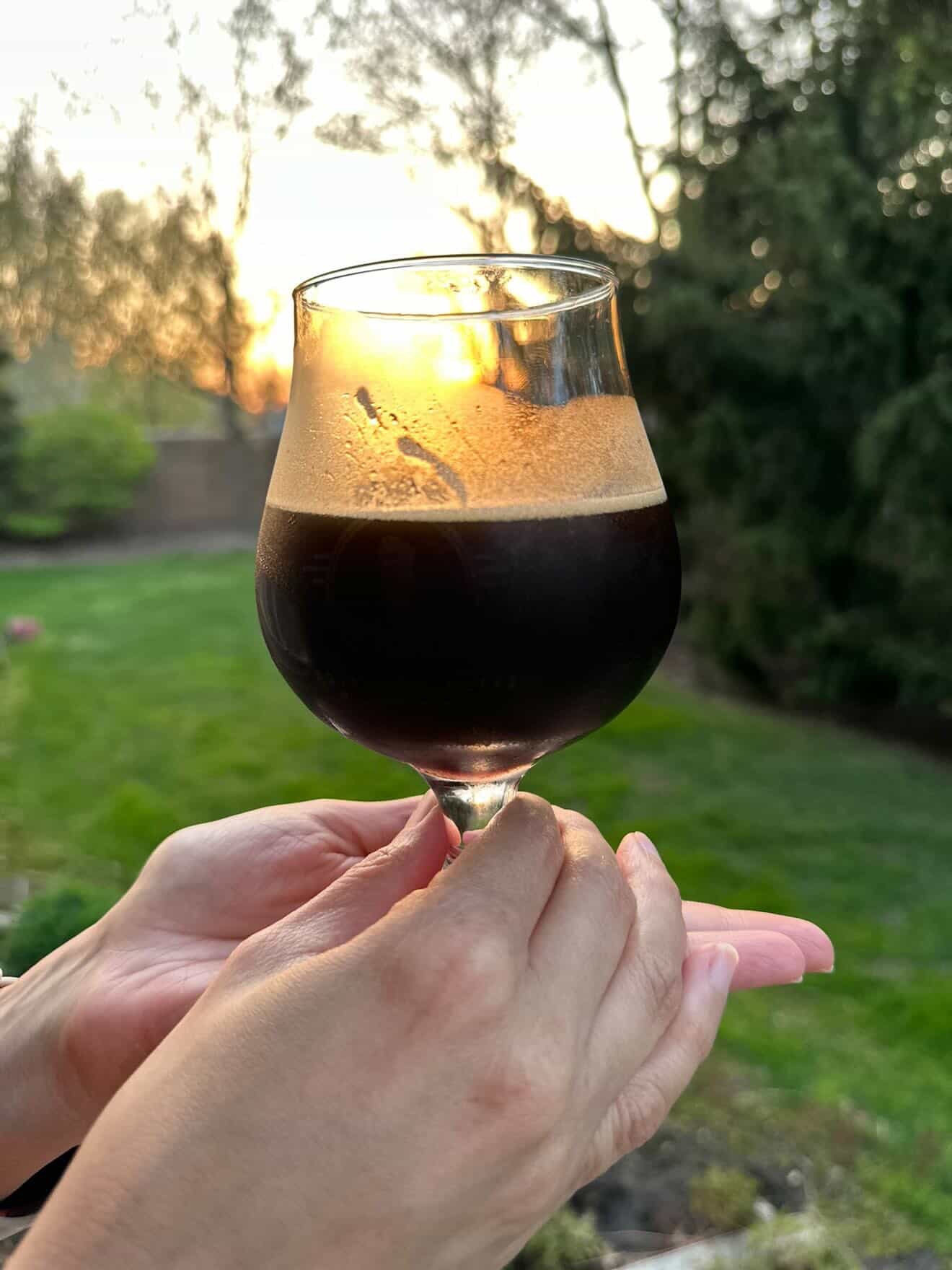

Some beers are brewed to style. Others are brewed to memory—and sometimes, to heritage.
For me, brewing has always gone hand in hand with another passion: cooking. Growing up with Indian cuisine, I was surrounded by layers of aroma—spices blooming in hot oil, the rhythm of a “tadka,” the balance between heat, warmth, and depth. Indian food isn’t just about flavor; it’s about balanced composition.
Years later, while exploring craft beer, I stumbled upon something that felt strangely familiar. At a bar in Atlanta, I tasted a beer from Ballast Point Brewing Company inspired by “Madras Curry.” It was bold, unexpected, and deeply layered—much like the food I grew up with.
I never found that beer again. But I never forgot it.
When I eventually started brewing my own beer, that memory stayed with me. And one day, I decided to bring it back—not as a clone, but as an interpretation.
That beer became “Curry Stout”.
Building a Stout That Can Carry Spice
The foundation had to be deliberate. A typical stout wouldn’t work—too much roast would overpower the spices, too little would leave the beer feeling thin and undefined.
Instead, I built a high-gravity stout (OG ~1.090, finishing ~1.023, ~8.8% ABV) with a layered malt bill designed for balance. A combination of 2-row and Maris Otter formed the backbone, while flaked oats added body and smoothness. Chocolate malt, roasted barley, and debittered black malt contributed structure without harshness, and a touch of molasses rounded everything out with a subtle dark sugar note.
Hops were intentionally restrained (~36 IBUs) —present enough to balance, but never to compete.
Because in this beer, hops play a supporting role.
Translating Curry Into Beer
The real challenge wasn’t brewing a stout—it was translating the essence of Indian curry into beer without turning it into a novelty.
Curry isn’t a single flavor. It’s a system—coriander, cumin, pepper, chili, turmeric, curry leaves—each contributing something distinct. The key was layering these elements carefully.
Rather than adding spices during the boil, I approached it more like cooking.
Stage 1 – Tincture Extraction
Toasted coconut, black pepper, coriander, and curry leaves were crushed and steeped in vodka to extract clean, controlled aromatics.
Stage 2 – Tadka-Inspired Addition
The second addition borrowed directly from Indian cooking technique. Using a maltodextrin-based medium, spices like garam masala, dried red chili, lemon zest, and curry leaves were gently heated—mimicking the traditional “tadka”, where spices are bloomed to unlock their full potential.
This step wasn’t just about flavor—it was about expression.
To finish, toasted coconut was added to soften and round the profile, bringing a subtle sweetness that tied everything together.
The Result: Familiar, Yet Unexpected
The finished beer doesn’t taste like curry in the literal sense—and that’s exactly why it works.
Instead, it presents as a rich stout with an evolving aromatic profile. The nose carries hints of warm spice layered over chocolate and roast. On the palate, the spices integrate rather than dominate, adding depth and intrigue without overwhelming the base beer.
It’s not spicy in the way you’d expect. It’s not loud.
It’s just… different.
Recognition for the Unconventional
When “Curry Stout” was entered into the 2024 Michigan Beer Cup—one of the largest homebrewing competitions in the state—it stood among precise, style-driven entries.
It earned a bronze medal in the Specialty Beer category .
For a beer that doesn’t fit neatly into any guideline, that recognition meant something more. It showed that even within structured judging, there’s room for creativity—when it’s executed with intent.
Why Brew Something Like This?
Because brewing, like cooking, is ultimately about expression.
“Curry Stout” is where those two worlds meet—Indian culinary tradition and modern craft brewing. It’s a reflection of heritage, curiosity, and a willingness to experiment beyond the expected.
Not every beer needs to follow a category.
Some just need to tell a story.

Recipe
59.2% efficiency – Adjust accordingly to your system.
Batch Volume: 5.5 gal (20.8 L)
Boil Time: 90 min
Mash Water: 7.09 gal (26.8 L)
Sparge Water: 4.7 gal (17.8 L)
Total Water: 11.79 gal (44.6 L)
Boil Volume: 9.02 gal (34.1 L)
Pre-Boil Gravity: 1.064
Original Gravity: 1.090
Final Gravity: 1.023
IBU (Tinseth): 36
BU/GU: 0.40
Color: 57 SRM
Mash
Strike Temp — 167 °F (75 °C)
Temperature — 155 °F (68 °C) — 60 min
Malts (20 lb 4 oz / 9.2 kg)
9 lb (4.1 kg) (39.1%) — 2-Row Malt — 1.9 °L
7 lb 8 oz (3.4 kg) (32.6%) — No.19 Floor Malt Maris Otter— 2.8 °L
1 lb (454 g) (4.4%) — Caramel / Crystal 120L — 89.1 °L
1 lb (454 g) (4.4%) — Chocolate — 258.9 °L
1 lb (454 g) (4.4%) — Mroost 1400 MD (Debittered black malt) — 388.1 °L
12 oz (340 g) (3.3%) — Organic Roasted Barley — 222 °L
Other (2 lb 12 oz / 1.25 kg)
2 lb (907 g) (8.7%) — Flaked oats — 2.4 °L
12 oz (340 g) (3.3%) — Molasses — 59.6 °L
Hops (1.8 oz / 51 g)
0.8 oz (22.7 g) (29 IBU) — Nugget 15.3% — Boil — 60 min
0.5 oz (14.2 g) (5 IBU) — Willamette 6.28% — Boil — 25 min
0.5 oz (14.2 g) (2 IBU) — Willamette 6.28% — Boil — 5 min
180 °F/°82C Whirlpool/Hopstand Time: 20 min (Optional)
I usually try to get wort down to ~180/82 as soon as I can before I whirlpool so that I can avoid additional hops utilization beyond the boil time.
Miscs (See instructions below)
24 items — Black Pepper — Secondary
1 tbsp — Coariander Seeds — Secondary
3 tbsp — Curry Leaves – Powder — Secondary
5 items — Dry Indian Red Chili — Secondary
2 tsp — Indian Grama Masala Powder — Secondary
1.5 tbsp — Lemon Zest — Secondary
4 oz (113 g) — Maltodextrin — Secondary
30 items — Curry Leaves — Secondary
3 lb (1.36 kg) — Toasted Coconut — Secondary
Yeast
2 pkg — Imperial Yeast A10 Darkness 75%
Fermentation
Primary — 68 °F (20 °C) — 14 days
Carbonation: 2.2 CO2-vol
Full Brewfather Recipe
Notes:
Keep hops on lower side.
Dry roast/toast 2lb of coconut flakes, 12 black peppers, coriander seeds, 15 curry leaves, and 2 tbsp curry leaves powder. Crush them. Then make a tincture of these ingredients in 2-4oz of vodka. This tincture is the first addition to the secondary.
3 days later the first tincture addition – heat a pan, add a little of water, bring it to boil. Add maltodextrin, stir it. Amount of water needed is just enough to make a base in the pan that is viscous with maltodextrin, so that spices do not burn. Do not add too much of water. That will make spices boil instead of wet roast with maltodextrin. Treat this as heating oil in the pan to do an Indian “tadka”, just that instead of oil, it is water+maltodextrin. Add dry red chili, garam masala, 1lb of coconut flakes, lemon zest, 15 curry leaves, 12 black peppers. Keep stirring them until water evaporates and a thick mixture is left. Let it cool down and then add to the secondary (as the second addition).
Rack to keg after 5 days of the second addition. Condition at 50°F/10°C for another 10-14 days.
Bronze medal at Michigan Homebrew Festival – Michigan Beer Cup 2024 for Specialty Beer category
By Anand Nath, Nath Brew Works.
Stay up to date on Instagram

Check out more great content!

A Place Between Seasons: Brewing with Kernza by Billy’s Tavern
After trying Pure Project’s Kernza lager and Deschutes’ Kernza lager, I’d been wanting to brew one myself for a while. This is a clean, crushable lager built around a grain most people have never heard of. I got the Kernza from a friend at work who started homebrewing. He hasn’t had the time to brew,…


Inside White Labs: Yeast Tour with Oil Creek Brewing!
Did you know White Labs has its own brewery along with its famed yeast propagation laboratory? White Labs is well known for its yeast. Since its early origins in California in 1995 but what you maybe didn’t know is that it has a very interesting approach to their brewery. I was fortunate enough to meet…

More Than Grain: Why Great Beer Starts with Montana’s Local Malt
In craft beer, people often talk about hops, yeast, and brewing techniques, but every great beer starts with malt. Over the last several years, Montana Craft Malt has built a reputation that goes beyond simply supplying grain. They have become a trusted partner for brewers who value quality, consistency, and a connection to where their…
Leave a Reply