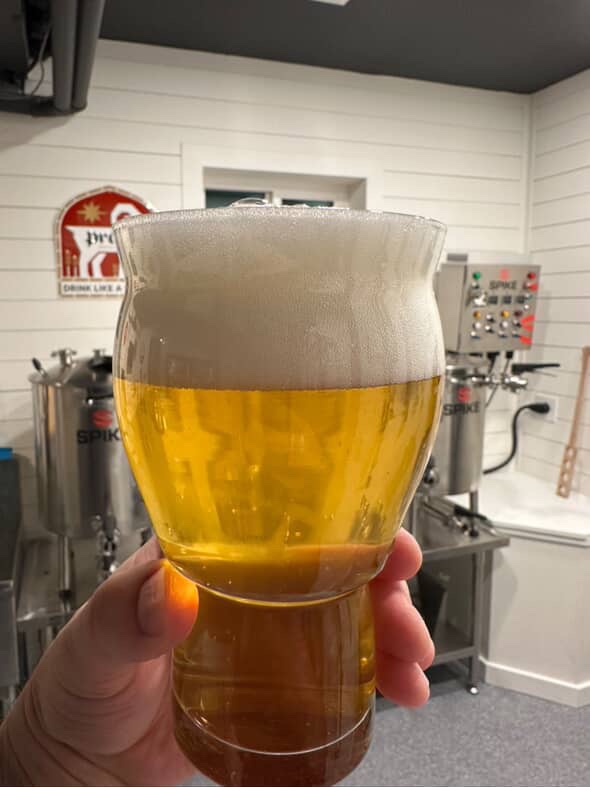

In a beer world ruled by haze, don’t count out the classics! West Coast IPAs are not only holding strong, they’re making a comeback. While New England IPAs (NEIPAs) continued to top the charts as the most popular IPA style in the U.S. in 2024, the crisp, clear bite of West Coast IPAs saw a significant resurgence.
West Coast IPAs are a fantastic style to brew, and if you’ve never made one, now’s the perfect time to change that. Here’s why I highly recommend it.
First, they’re all about balance and precision. With a firm bitterness, bright hop aroma, and a crisp, dry finish, West Coast IPAs let the hops shine without being overwhelmed by sweetness or haze. They’re a great way to showcase your hop selection and dialing in your water chemistry and fermentation process can really elevate the end result.
Second, they’re incredibly rewarding to brew. You get to experiment with layering classic American hops like Simcoe, Centennial, and Amarillo. Or better yet, explore modern varieties that bring citrus, pine, and dank resinous character. The clarity and bitterness also make them an excellent choice for testing your skills with fining agents and proper yeast handling.
And finally, they’re refreshing. In a sea of hazy IPAs, a well-crafted West Coast IPA hits with a clean snap that hop lovers crave. If you’re looking for a beer that’s bold, bright, and unapologetically hoppy! Brew a West Coast. You won’t regret it.

Note: This recipe was scaled down from 12 gallons to 5 gallons. The brewfather link below will be a 12 gallon recipe.
Recipe
71.7% efficiency
Batch Volume: 5 gal / 18.93 L
Boil Time: 60 min
Mash Water: 4.38 gal / 16.58 L
Sparge Water: 3.14 gal / 11.89 L
Total Water: 7.52 gal / 28.47 L
Boil Volume: 6.65 gal / 25.17 L
Pre-Boil Gravity: 1.059
Original Gravity: 1.065
Final Gravity: 1.011
IBU (Tinseth): 72
BU/GU: 1.11
Color: 3.9 SRM
Mash
Mash — 152 °F / 66.7 °C — 60 min
Mash Out — 170 °F / 76.7 °C — 10 min
Malt
11.25 lb (96.5%) — Root Shoot Pilsner or Montana Craft Pilsner
0.42 lb (3.5%) — Carapils
0.42 lb — Dextrose (Boil — 60 min)
Hops (AA% depending)
0.83 oz / 23.55 g (~28 IBU) — Simcoe 14.4% — First Wort
0.83 oz / 23.55 g (~25 IBU) — Simcoe 14.4% — 60 min
0.83 oz / 23.55 g (~5 IBU) — Lupomax Amarillo 14.5% — Hopstand at 180 °F / 82.2 °C — 15 min
0.83 oz / 23.55 g (~5 IBU) — Lupomax Centennial 14% — Hopstand at 180 °F / 82.2 °C — 15 min
0.83 oz / 23.55 g (~6 IBU) — Lupomax El Dorado 17.5% — Hopstand at 180 °F / 82.2 °C — 15 min
0.83 oz / 23.55 g (~5 IBU) — Simcoe 14.4% — Hopstand at 180 °F / 82.2 °C — 15 min
Dry Hop — 3 days:
1.67 oz / 47.34 g — Lupomax Amarillo
1.67 oz / 47.34 g — Lupomax El Dorado
0.83 oz / 23.55 g — Lupomax Centennial
0.83 oz / 23.55 g — Simcoe
Yeast
WLP001 – American Ale
Fermentation
Primary — 68 °F / 20.0 °C — 2 days
Primary — 70 °F / 21.1 °C — 3 days
Dry Hop — 55 °F / 12.8 °C — 3 days
Cold Crash/Carb — 34 °F / 1.1 °C — 2 days
Water Profile
Ca²⁺ 75
Mg²⁺ 5
Na⁺ 10
Cl⁻ 50
SO₄²⁻ 139
HCO₃⁻ 16
Brewfather Recipe

By John, Ironton Brewing
Follow on Instagram
WANT TO WIN FREE YEAST?!


Inside White Labs: Yeast Tour with Oil Creek Brewing!
Did you know White Labs has its own brewery along with its famed yeast propagation laboratory? White Labs is well known for its yeast. Since its early origins in California in 1995 but what you maybe didn’t know is that it has a very interesting approach to their brewery. I was fortunate enough to meet…


More Than Grain: Why Great Beer Starts with Montana’s Local Malt
In craft beer, people often talk about hops, yeast, and brewing techniques, but every great beer starts with malt. Over the last several years, Montana Craft Malt has built a reputation that goes beyond simply supplying grain. They have become a trusted partner for brewers who value quality, consistency, and a connection to where their…

CellarScience Instant Water: Simplifying One of Brewing’s Most Confusing Starting Points
Water chemistry is one of those things almost every homebrewer eventually gets told they need to learn. So you start reading about it, and before long you’re staring at water reports, sulfate and chloride ratios, mash pH targets, and calculators that make your head spin. At least that was my experience. Brewfather has helped a…
Leave a Reply